Table of Contents

Free Wi-Fi is no longer just a nice perk for customer-facing businesses. Whether you run a hotel, café, clinic, retail space, or coworking office, customers don’t just hope for a quick connection; they actively expect it.
However, offering free internet only delivers real value when it is reliable, secure, and properly designed. A slow, unstable, or poorly secured guest network can quickly frustrate your visitors and create unnecessary security risks for your business. To get it right, free Wi-Fi must be treated as a core part of your IT ecosystem, not just a password scribbled on a receipt.
Why Businesses Offer Free Wi-Fi to Customers
For modern businesses, guest Wi-Fi supports both service quality and commercial goals. By providing Wi-Fi as a simple in-store tactic, cities and businesses can draw foot traffic, connect with potential customers, and help people check messages, work remotely, access digital menus, complete forms, or stay connected while waiting.
When done right, offering free Wi-Fi helps businesses attract customers and increase foot traffic:
- Improve the customer experience: Reduce perceived wait times and add immediate convenience.
- Encourage longer visits: Customers who can stay connected often spend more time and money, which can also help convert new customers.
- Support customer loyalty: People return to places where they can work and browse effortlessly.
- Strengthen brand perception: A fast, seamless login process makes your business look professional and customer-focused.
- Capture marketing insights: A well-designed guest portal enables you to share digital promotions and collect customer data responsibly.
Driving Engagement and Loyalty
1. Reducing Friction in the Customer Journey
A reliable Wi-Fi connection helps remove minor annoyances during a customer’s visit. A clinic patient can complete digital intake forms from their phone, a hotel guest can smoothly join a video call from the lobby, a visitor can use mobile devices to connect to the internet on-site, and a retail shopper can instantly compare product details. It gives customers one less reason to feel inconvenienced while on your premises, and good connectivity reduces friction for visitors.
2. Balancing Long Stays with Business Goals
While free Wi-Fi encourages customers to stay longer, these extended visits should always align with your operational needs. For example, a café might welcome remote workers during slow mid-afternoon hours but may need to implement time limits during peak lunch rushes. A clinic needs simple access for patients without exposing internal medical systems. The best approach seamlessly integrates with your specific daily operations.
3. Turning Wi-Fi into a Marketing Tool
A reliable guest network can serve as a marketing tool and a key driver of customer loyalty. By utilizing a captive portal (a custom login page), businesses can share current promotions, encourage newsletter sign-ups, or highlight upcoming events while capturing customer emails and limited demographic or business information with proper consent.
Did you know? Statistics show that 74% of customers prefer to receive promotions directly via the store Wi-Fi. Login flows can also encourage social media check-ins for easy, organic marketing. Of course, this should always be handled responsibly, with clear privacy practices and transparent user consent, but free Wi-Fi access can also help attract people.
Performance Matters: Unmanaged vs. Managed Wi-Fi
In retail and hospitality, reliable free Wi-Fi can influence where customers choose to spend their time and money. Cisco data cited by Shopify found that 96% of consumers prefer shopping at stores with free Wi-Fi and are more likely to return, while Oracle found that nearly 60% of shoppers expect in-store Wi-Fi. However, offering free Wi-Fi can easily backfire if the connection is slow or constantly drops. If your staff spends half their shift troubleshooting router issues for frustrated guests, your network is hurting your brand.
To understand the difference between a basic setup and an enterprise-grade solution, consider the following comparison:
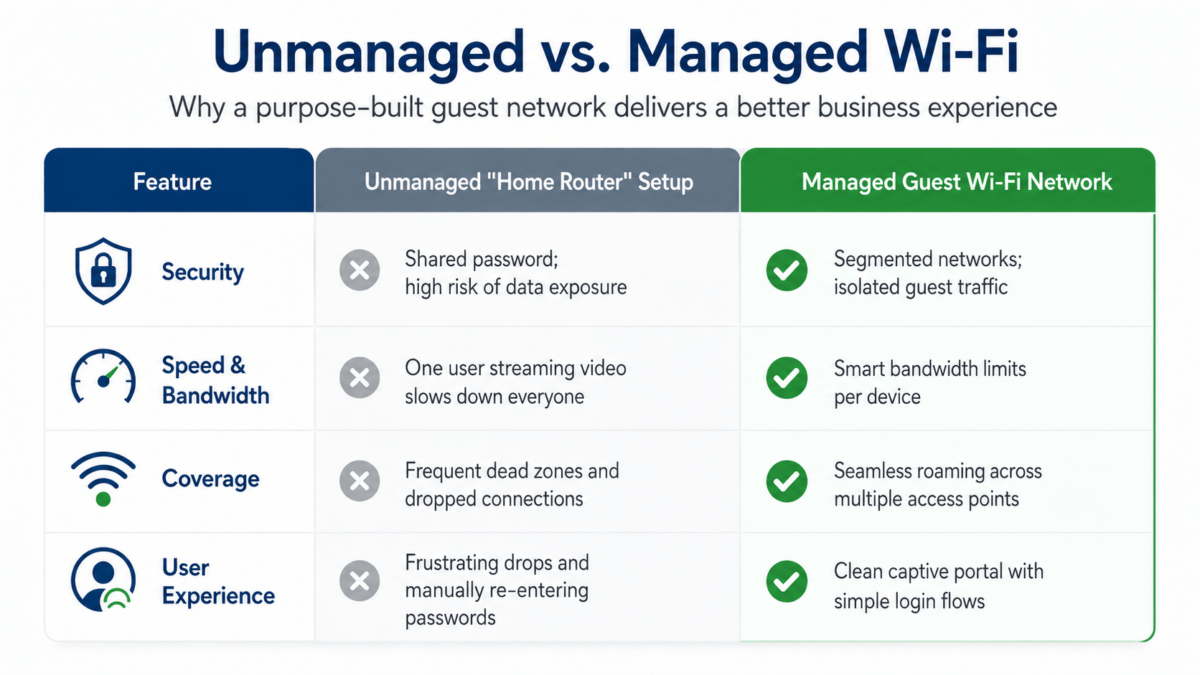
Wireless performance relies entirely on the wired infrastructure supporting it, and security and performance should be maintained at the same level across access points and locations. Local Area Network (LAN) cabling, switches, internet circuits, and network hardware all dictate the quality of the end-user experience.
Designing a High-Performing Guest Network
Strategic Access Point Placement
More hardware doesn’t automatically equal better coverage. Access points that are poorly placed can interfere with each other, degrading performance and creating dead zones, because good connectivity depends as much on placement as on the number of access points. A professional wireless site survey(or RF site survey) helps map out the exact locations, settings, and hardware required to deliver uniform coverage in complex layouts such as hotels, warehouses, and multi-floor offices. Proper placement also improves public Wi-Fi coverage and supports reliable internet access across the property.
Smart Capacity Planning
A network that works perfectly for three people might crawl to a halt when thirty people join on mobile devices to stream video, download files, or jump on calls. Smart capacity planning involves monitoring peak usage times, predicting device density, and dynamically allocating bandwidth so that your guest network never chokes during your busiest hours, preserving reliable internet access and supporting better turnover in high-traffic venues.
Security First: Protecting Your Business and Your Guests
Security is the most critical element of any public Wi-Fi deployment. Your guest network must remain completely isolated from internal business operations. Users on public Wi-Fi should also use a Virtual Private Network (VPN) to help protect their devices.
Critical Security Checklist:
- Network Segmentation: Keep guest traffic completely separate from internal point-of-sale (POS) systems, servers, employee devices, and printers.
- Strong Encryption & Controls: Apply the same level of protection across all guest access points, with up-to-date encryption standards and secure administrator passwords.
- Regular Firmware Updates: Patch network hardware routinely to guard against emerging vulnerabilities.
- Access Rules: Implement daily password changes, receipt-based codes, or session time limits to stop neighbors or unauthorized users from draining your bandwidth.
The Broader Impact: Wi-Fi as a Community Asset
Beyond commercial venues, the positive impact of free Wi-Fi extends deeply into public spaces, libraries, parks, and community centers. In many countries, providing free, reliable internet access in these environments is a considerable benefit because it helps bridge the digital divide. It grants low-income users and those facing financial constraints internet access to assignments, research materials, educational videos, and other online resources that build digital literacy, support skills development, and can improve academic performance. It also helps people in rural areas reach essential services, including remote access to doctors.
Public connectivity also supports local economies by attracting foot traffic to downtown districts, helping young entrepreneurs stay connected on the move, reducing overhead costs, creating more opportunities, and promoting ventures through social media. It also benefits tourism by helping visitors navigate cities, connect with loved ones, share experiences online, save on mobile data, and avoid roaming fees, while residents still have instant access to city navigation and emergency alerts. Municipalities can also analyze anonymous traffic patterns and broadcast local news and alerts. Overall, public Wi-Fi strengthens community involvement and community bonds while supporting instant communication and digital payments.
Make Free Wi-Fi a Better Business Asset
When properly designed, free Wi-Fi boosts customer satisfaction, builds brand loyalty, and protects your operational efficiency. When neglected, it becomes a liability.
EIRE Systems helps organizations design, assess, optimize, and secure Wi-Fi environments tailored to real business needs. From professional wireless site surveys and strategic access point placement to strict guest network isolation, our team ensures your visitors enjoy a seamless experience while your internal business systems stay completely secure.
Contact EIRE Systems today to review your current wireless infrastructure or to design a secure, high-performance guest Wi-Fi network for your business.
Sources:
- Econsultancy. (2013, March 14). More reasons for retailers to offer Wi-Fi in stores. https://econsultancy.com/more-reasons-for-retailers-to-offer-wi-fi-in-stores/
- Information-technology Promotion Agency, Japan. (2026). Information security measures guidelines for SMEs, Version 4.0. https://www.ipa.go.jp/security/guide/sme/ug65p90000019cbk-att/sme_guideline_v4.0.pdf
- Ministry of Internal Affairs and Communications. (n.d.). Wireless LAN (Wi-Fi) security guidelines. https://www.soumu.go.jp/main_sosiki/cybersecurity/wi-fi/index.html
- Shopify. (2026, May 27). Grow retail sales with smart Wi-Fi marketing. https://www.shopify.com/ph/blog/wifi-marketing-what-it-is-and-how-retailers-can-use-it
- Tokyo Metropolitan Government. (2023). Cybersecurity measures for SMEs, Version 2.2a. https://www.cybersecurity.metro.tokyo.lg.jp/security/docs/chapter02_Ver.2.2a.pdf
About the Author: Regi Azubuike

Regi Azubuike is an IT and networking professional with experience in network infrastructure and business infrastructure. His areas of focus include network performance, wireless connectivity, infrastructure planning, troubleshooting, and maintaining secure access across modern workplaces.