
Table of Contents

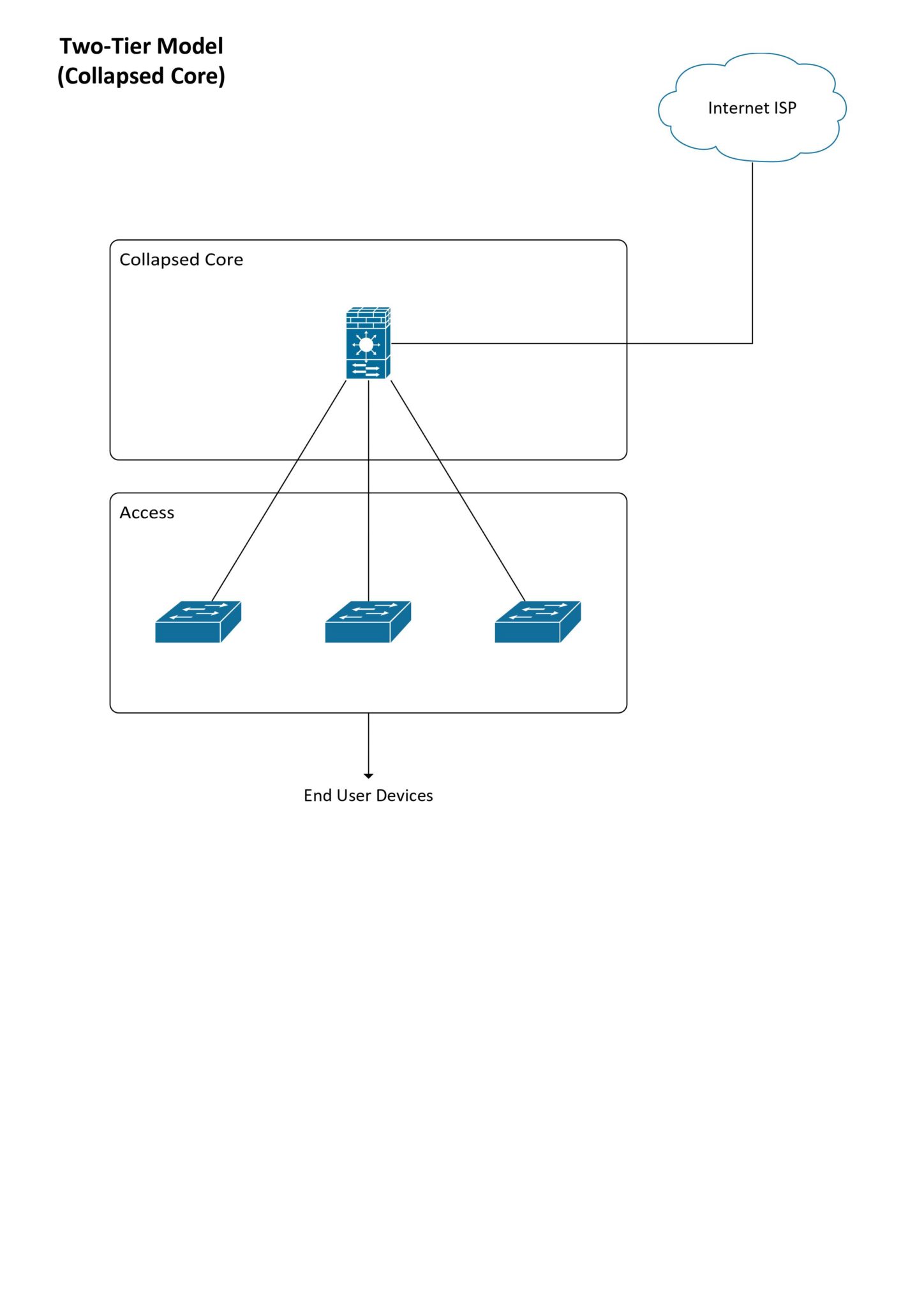
When planning an enterprise campus network, organizations commonly choose between a three-tier and two-tier architecture. A collapsed core network is a two-tier design that combines the distribution and core functions into a single layer on the same switching platform, rather than separating access, distribution, and core into three layers.
This model is often a good fit for IT professionals, network engineers, and decision-makers designing small-to-medium-sized campus networks, especially in a single-building office or in environments with a limited number of access switches. It can preserve the benefits of a hierarchical network while reducing hardware, cabling, configuration, and day-to-day management.
The tradeoff is that the architecture you choose directly affects cost, complexity, scalability, performance, and operations. The sections that follow explain how a collapsed core works, how it compares with a three-tier design, where it fits well, where its limits appear, and how to plan for future growth based on application traffic, availability requirements, security policies, physical layout, wireless demand, and expected expansion.
What Is Collapsed Core Architecture?
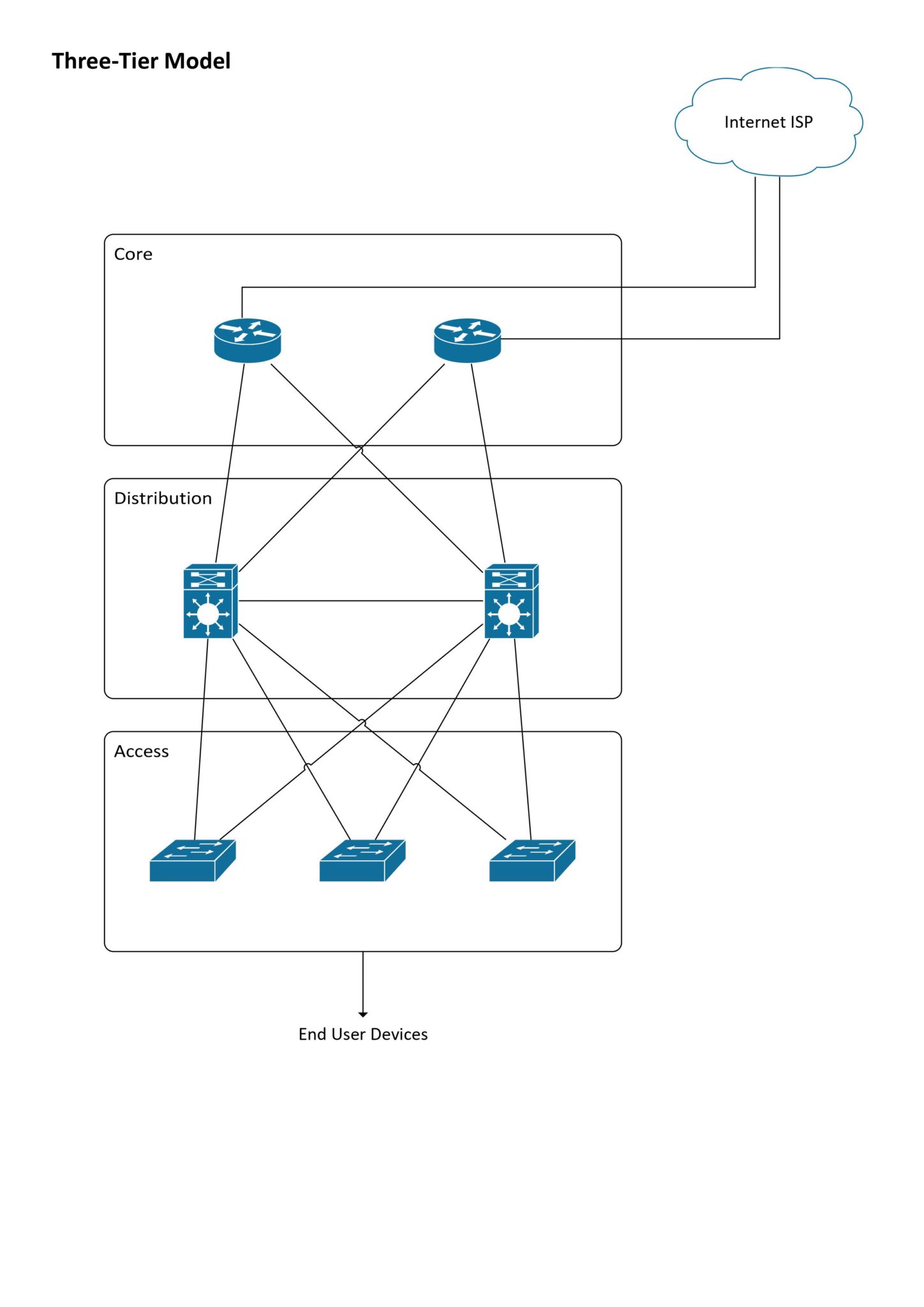
A traditional three-tier campus network contains three functional layers:
- Access layer: Connects computers, phones, printers, wireless access points, cameras, and other endpoint devices.
- Distribution layer: Aggregates access switches and applies routing, segmentation, security policies, and quality of service.
- Core layer: Provides fast, resilient transport between distribution blocks and major network services.
In a collapsed-core architecture, the core and distribution functions are implemented in the same layer.Cisco describes it as a two-tier design in which the distribution layer serves as the Layer 3 aggregation point for access devices and may also connect WAN infrastructure, wireless controllers, network services, and the internet edge.
The term “collapsed” does not mean the network is incomplete. It means two logical functions are delivered by the same switching platform or, in resilient environments, a redundant pair of switches.
How Does a Collapsed Core Network Work?
Access switches connect users and devices throughout an office or campus. These switches connect upstream to the collapsed core, where traffic is aggregated and routed between virtual LANs, servers, cloud services, business applications, and internet connections.
The combined layer may also enforce access controls, segmentation, and quality-of-service policies. With fewer layers requiring communication, protocols are simpler and operational complexity is reduced. Because it performs several important functions, business-critical environments should generally use redundant switches, uplinks, and power supplies rather than relying on one physical device.
Collapsed Core vs. Three-Tier Network Design
A collapsed core network is usually appropriate when one distribution block can efficiently support the organization’s access switches and shared services.
A three-tier architecture is more useful when the organization must interconnect several distribution blocks, buildings, or major service areas, and scalability differences matter, as a three-tier design is generally more scalable than a collapsed core design in those cases. Cisco recommends considering a dedicated core when at least three distribution blocks need to be connected. Port capacity, bandwidth, geographic dispersion, change risk, and failure-domain size are also important design factors.
The decision should not be based only on a fixed number of users or devices. Throughput, port density, fiber availability, traffic patterns, redundancy, expansion plans, and whether a less scalable design will limit growth may be more important.
Organizations preparing for an office move or infrastructure upgrade may benefit from professional IT consulting and project management services before selecting an architecture.
Benefits of a Collapsed Core Network
Lower Infrastructure Costs
Combining core and distribution functions can reduce the number of switches, optics, racks, power connections, support contracts, and inter-device links required. This can reduce both initial and ongoing costs, lowering overall costs, but it also means fewer devices are needed to handle more functions, resulting in lower redundancy than a comparable three-tier design.
Simplified Network Operations
A two-tier architecture has only two layers that need to communicate, making it easier to configure, monitor, and troubleshoot, while simplified protocols help reduce the complexity found in more complex designs. Traffic paths are generally easier to understand, helping engineers isolate connectivity problems more efficiently.
Simplification does not remove the need for careful planning. Routing, VLANs, access controls, monitoring, backups, and failover procedures still need to be documented and tested.
Efficient Use of Modern Hardware
Modern enterprise switches can support Layer 3 routing, high-speed uplinks, security controls, and redundancy on one platform. A collapsed core design leverages these capabilities without adding a separate core layer, which may offer little value at the organization’s current scale.
Suitable for Smaller Campuses
Juniper Networks identifies collapsed core as a small- to mid-sized enterprise architecture that traditionally uses up to two interconnected switching platforms. It is a common fit for a small network of up to 200 devices and for medium campus networks of about 200 to 1000 devices that a well-planned design can handle.
It can be effective for a single building, a compact campus, a regional office, or a branch headquarters. Wired and wireless requirements should be planned together. EIRE Systems’ Wi-Fi design services consider connected devices, applications, expected traffic, coverage, and wired switch requirements.
Limitations of a Collapsed Core Network
Scalability Constraints
Because the collapsed core performs both backbone and aggregation functions, port capacity, forwarding performance, uplink bandwidth, and service density can eventually become constraints, and medium deployments often top out around 1000 devices before a more modular design becomes easier to scale.
Organizations expecting new buildings, acquisitions, or major traffic growth should determine whether a three-tier architecture offers a better long-term foundation and whether they can adjust the network as demand increases.
Newer technologies such as EVPN-VXLAN (Ethernet VPN-Virtual Extensible LAN) can enhance the flexibility and scalability of certain collapsed core designs, though licensing, compatibility, complexity, and operational expertise must be considered.
Larger Failure Domain
A collapsed core concentrates several major functions into a single layer. If it relies on a single device, that device becomes a single point of failure. Even with redundant equipment, resilience is typically lower than in a three-tier architecture because more services and individual components depend on the same collapsed core layer, so a configuration or software issue may affect routing, access aggregation, and shared services simultaneously.
Consolidating LAN, WAN, and other services into a single distribution layer can increase the impact of operational errors and maintenance changes.
Maintenance Planning
Software upgrades, hardware replacements, and policy changes at the collapsed core can affect a broad portion of the network. Maintenance plans should include configuration backups, compatibility checks, failover testing, rollback instructions, and replacement equipment.
Ongoing IT support and network monitoring can help businesses maintain performance and respond to developing issues.
Limited Space for Additional Services
As the organization grows, the combined layer may need to support more firewalls, WAN links, wireless controllers, security tools, servers, and cloud connections. When these services become difficult to connect or manage, separating the core and distribution layers can improve modularity and scalability.
Should You Choose a Collapsed Core Design?
A collapsed core network may be suitable when:
- The network supports either a single building or a compact campus.
- One redundant switch pair can aggregate the access layer.
- Current and projected traffic are within platform capacity.
- The organization wants to control cost and complexity.
- The design includes a realistic expansion path.
A three-tier model may be more appropriate when the network spans multiple buildings, requires several distribution blocks, or needs stronger separation between services and failure domains.
The best architecture is the one that supports users, applications, security, operations, and growth without unnecessary complexity.
Plan a Network That Supports Future Growth
A collapsed core network can provide a cost-effective, resilient, and manageable foundation for many small- and medium-enterprise environments. Success depends on selecting appropriate hardware, building redundancy, documenting requirements, and planning for expansion.
EIRE Systems provides network design, infrastructure implementation, Wi-Fi planning, documentation, project management, and ongoing support for organizations in Japan and across the Asia-Pacific region. Contact EIRE Systems to assess your current environment or plan a network architecture that supports your business as it grows.
Sources
- Cisco. (n.d.). Campus LAN and wireless LAN solution design guide. https://www.cisco.com/c/en/us/td/docs/solutions/CVD/Campus/cisco-campus-lan-wlan-design-guide.html
- Juniper Networks. (2023, September 20). Overview of a collapsed core with EVPN multihoming in a campus network. https://www.juniper.net/documentation/us/en/software/nce/nce-182-evpn-collapsed-core-evpn-multihoming-campus/topics/topic-map/overview.html
- Juniper Networks. (n.d.). Determine a campus fabric topology. https://www.juniper.net/documentation/us/en/software/mist/mist-wired/topics/concept/choose-campus-fabric-topology.html
About the Author: EIRE Systems

EIRE Systems is a leading independent provider of professional IT, AV and Access Security services to the financial, insurance, manufacturing, health care, retail, construction, hospitality, commercial real estate, legal, educational and multinational sectors in Japan and throughout the Asia Pacific region. EIRE Systems has expertise across a wide spectrum of Information Technologies, with a track record for successfully completing hundreds of assignments since its establishment in 1996.