
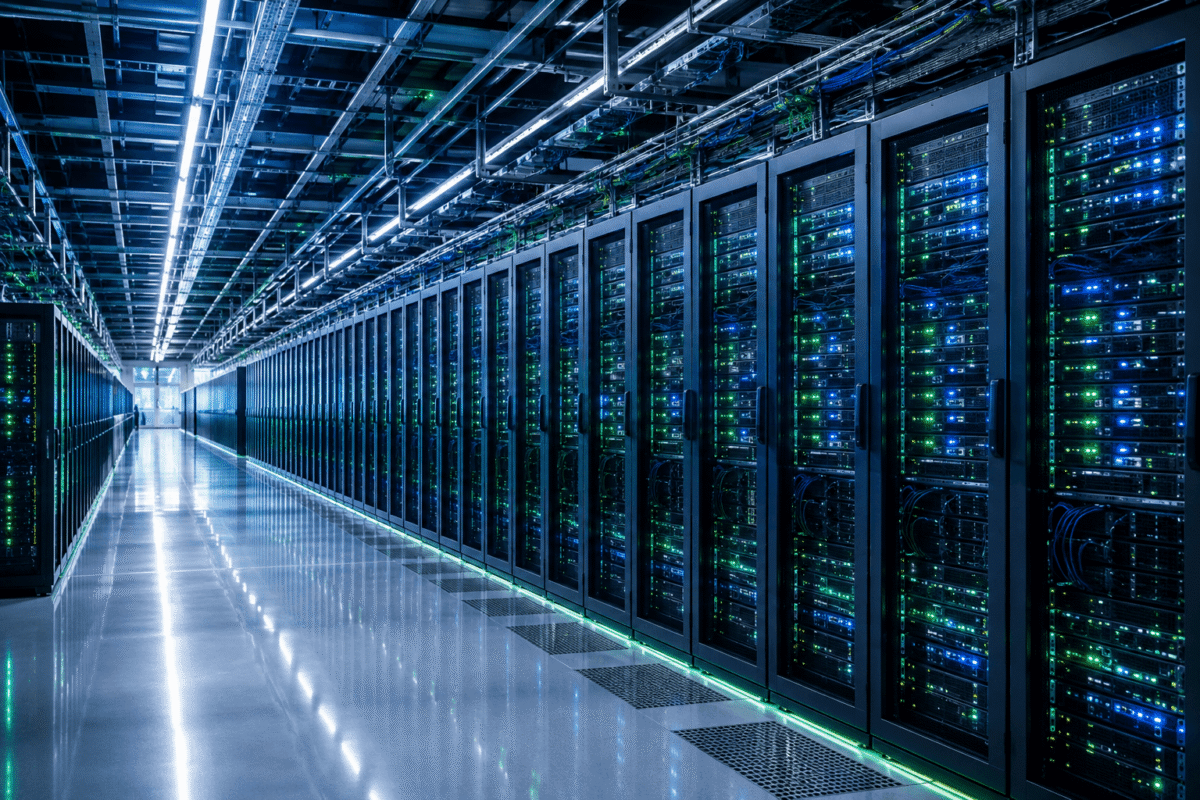
A hyperscale data center is a large, highly scalable facility designed to process, store, and distribute enormous volumes of data. These facilities provide the computing infrastructure behind cloud platforms, artificial intelligence applications, search engines, streaming services, social networks, and global business systems, making them central to modern digital operations.
Unlike a conventional enterprise data center built around one organization’s needs, a hyperscale facility uses standardized hardware, distributed systems, modular construction, and automation to expand rapidly as demand changes. For IT professionals, business decision-makers, and organizations evaluating cloud infrastructure, data center architecture, or scalable computing, understanding hyperscale data centers helps clarify how major platforms deliver capacity, efficiency, resilience, and global reach. This article explains how hyperscale data centers are built, how their size and scalability differ from traditional facilities, who operates them, what benefits and security considerations they bring, and how businesses can use hyperscale infrastructure.
What Does Hyperscale Mean?
Hyperscale refers to an infrastructure architecture that can efficiently increase or reduce computing capacity.
Rather than relying on a small number of highly customized systems, hyperscale environments typically use large groups of standardized servers that work together. Additional computing, storage, and networking resources can be added without redesigning the entire environment.
Hyperscale data centers are modular facilities that use horizontally scalable and software-defined infrastructure to support cloud computing, artificial intelligence, and other large workloads.
How Large Is a Hyperscale Data Center?
There is no universally defined size for a hyperscale data center. However, a commonly cited benchmark is a facility containing at least 5,000 servers and occupying more than 10,000 square feet.
Many hyperscale campuses are significantly larger. They may include several buildings, extensive network infrastructure, dedicated power systems, and space for future expansion.
Synergy Research Group reported that 1,136 hyperscale data centers were operating worldwide at the end of 2024. Another 504 facilities were being planned, built, or fitted out.
Size alone does not make a data center hyperscale. Its architecture must also allow computing capacity to expand efficiently and reliably.
What Makes a Data Center Hyperscale?
Hyperscale data centers generally include:
- Thousands of standardized, interconnected servers
- Large distributed storage systems
- High-capacity network connections
- Modular power, cooling, and server designs
- Centralized infrastructure management
- Automated provisioning and monitoring
- Redundant power, cooling, and connectivity
- Systems that redistribute workloads when equipment fails
Automation is essential at this scale. Manually configuring every server, network switch, and storage device would be inefficient and difficult to manage consistently.
Software is used to allocate resources, monitor equipment, balance workloads, identify failures, manage network traffic, and plan future capacity. This allows operators to manage large environments with greater consistency.
Who Uses Hyperscale Data Centers?
Hyperscale facilities are commonly operated by major cloud and technology companies, including:
- Amazon Web Services
- Microsoft
- Meta
- Alibaba
- Tencent
- Apple
Amazon, Microsoft, and Google collectively represented 59% of operational hyperscale capacity at the end of 2024.
Most businesses do not need to own a hyperscale facility. Instead, they access hyperscale infrastructure through services such as cloud hosting, online storage, hosted applications, backup platforms, artificial intelligence tools, and content delivery networks.
Organizations may also combine public cloud services with private infrastructure through a hybrid cloud strategy.
How Is a Hyperscale Data Center Different From a Traditional Data Center?
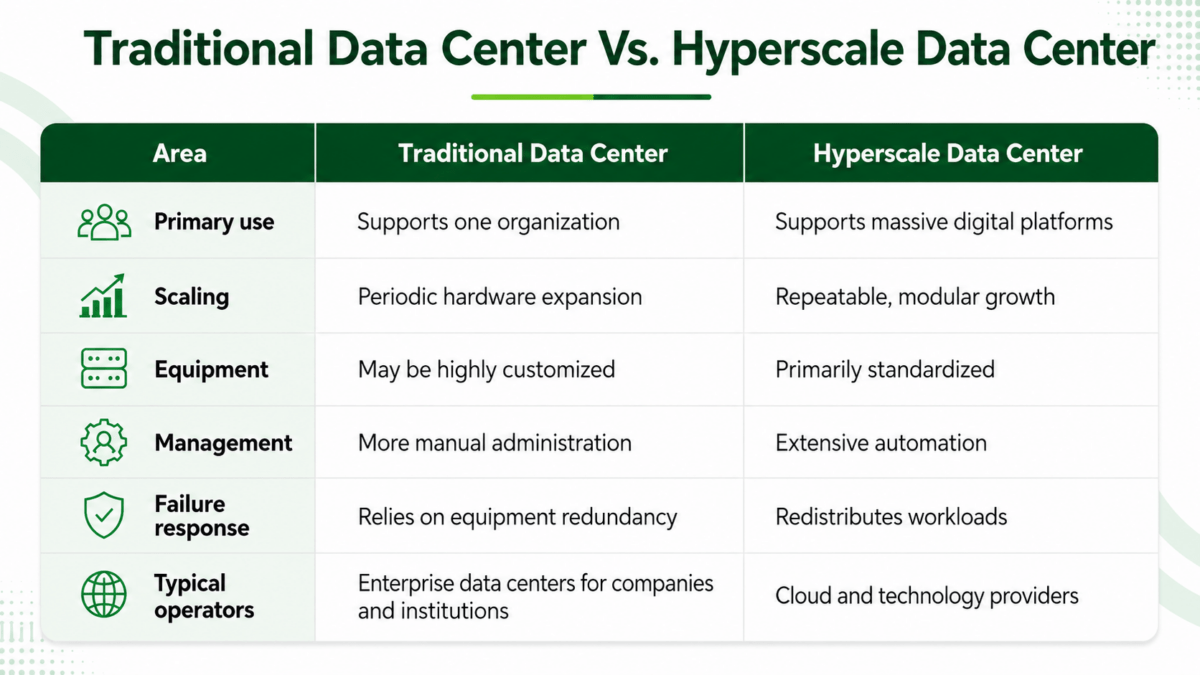
Traditional data centers are generally designed around the current and projected needs of one organization. Adding capacity may require hardware upgrades, construction, or changes to power and cooling systems.
A hyperscale data center is designed for continuous expansion. Standardized equipment, distributed systems, modular layouts, and automated management allow capacity to be added more quickly and support massive data processing.
Hyperscale is also different from colocation. A colocation provider rents secure space, power, cooling, and connectivity to customers. A colocation data center can be a good fit for organizations that want flexibility and lower upfront investment instead of building hyperscale infrastructure. Hyperscale describes the size and architecture of the computing environment, although hyperscale operators may lease wholesale colocation space.
Hyperscale facilities also often achieve lower Power Usage Effectiveness values than traditional facilities because of scale and design efficiencies.
Is Hyperscale the Same as a Tier IV Data Center?
No. Hyperscale and Tier IV describe different characteristics.
Hyperscale refers to the size, scalability, and architecture of the computing environment. Uptime Institute tier classifications evaluate the supporting facility infrastructure based on redundancy, maintainability, and fault tolerance.
A hyperscale data center is not automatically Tier IV. A Tier IV data center is also not necessarily hyperscale.
What Are the Benefits of Hyperscale Data Centers?
The primary benefits include:
- Scalability: Capacity can be added as user or workload demand increases.
- Performance: Distributed systems can support high-volume cloud, AI, analytics, and streaming workloads.
- Resilience: Workloads can be moved away from failed servers or other infrastructure components.
- Automation: Software reduces repetitive manual administration and improves consistency.
- Global reach: Providers can distribute applications and data across multiple geographic regions.
- Infrastructure efficiency: Standardized equipment and advanced cooling can improve resource utilization.
Data center efficiency is often measured using Power Usage Effectiveness, or PUE. PUE compares the total energy entering a facility with the energy used by its IT equipment. A result closer to 1.0 indicates less energy is being consumed by supporting systems such as cooling.
However, large data centers still require considerable electricity. The International Energy Agency estimated that data centers consumed approximately 415 terawatt-hours globally in 2024, representing around 1.5% of worldwide electricity consumption.
Are Hyperscale Data Centers Secure?
Hyperscale operators typically use several layers of physical and digital security, including controlled facility access, surveillance, encryption, network segmentation, identity management, threat monitoring, backups, and redundant infrastructure.
However, using a cloud provider does not transfer every security responsibility to that provider.
Customers may still be responsible for:
- User accounts and permissions
- Application security
- Data classification
- Cloud configurations
- Backup and retention policies
- Regulatory compliance
- Endpoint and device security
NIST recommends that organizations evaluate security, privacy, data location, contractual obligations, and incident response before moving systems into public cloud environments.
Does Every Business Need Hyperscale Infrastructure?
Most businesses do not need to build a hyperscale facility. Instead of relying only on small data centers or fully on-premises deployments, they can access hyperscale computing through public cloud services while keeping other systems on-premises, in private cloud environments, or in colocation facilities; some may also retain enterprise data centers for specific workloads.
The right infrastructure model depends on:
- Performance and latency
- Security and compliance
- Data residency
- Availability requirements
- Migration complexity
- Network connectivity
- Cost predictability
- Business continuity
- Future capacity needs
These are key factors when choosing between hyperscale infrastructure, private environments, or edge computing.
A workload assessment can help determine which applications should move to the cloud and which should remain in private infrastructure by accounting for the data generated and the computing power each workload requires.
How Can EIRE Systems Support Data Center and Cloud Projects?
EIRE Systems helps organizations plan, design, implement, relocate, and improve data center and cloud environments across Japan and the Asia-Pacific region.
Our IT consulting and project management services can support site assessments, requirements definition, infrastructure design, vendor coordination, commissioning, equipment relocation, and migration planning, with planning and design aligned to data center architecture, network performance, and data processing requirements.
We also help businesses evaluate public, private, hybrid, and multi-cloud solutions, including network connectivity, data storage, security, resilience, cloud readiness, and the computing resources needed for each model.
Contact EIRE Systems to discuss an infrastructure strategy that supports your current operations and future growth.
Sources
- Cisco. (n.d.). What is a hyperscale data center? https://www.cisco.com/site/us/en/learn/topics/computing/what-is-a-hyperscale-data-center.html
- International Energy Agency. (2025). Energy and AI: Executive summary. https://www.iea.org/reports/energy-and-ai/executive-summary
- Jansen, W., & Grance, T. (2011). Guidelines on security and privacy in public cloud computing (NIST Special Publication 800-144). National Institute of Standards and Technology. https://doi.org/10.6028/NIST.SP.800-144
- Synergy Research Group. (2025, March 19). Hyperscale data center count hits 1,136; average size increases; US accounts for 54% of total capacity. https://www.srgresearch.com/articles/hyperscale-data-center-count-hits-1136-average-size-increases-us-accounts-for-54-of-total-capacity
- The Green Grid. (n.d.). TGG glossary: Power Usage Effectiveness. https://www.thegreengrid.org/resources/glossary
- Uptime Institute. (n.d.). Tier Standard: Topology. https://uptimeinstitute.com/resources/asset/tier-standard-topology