
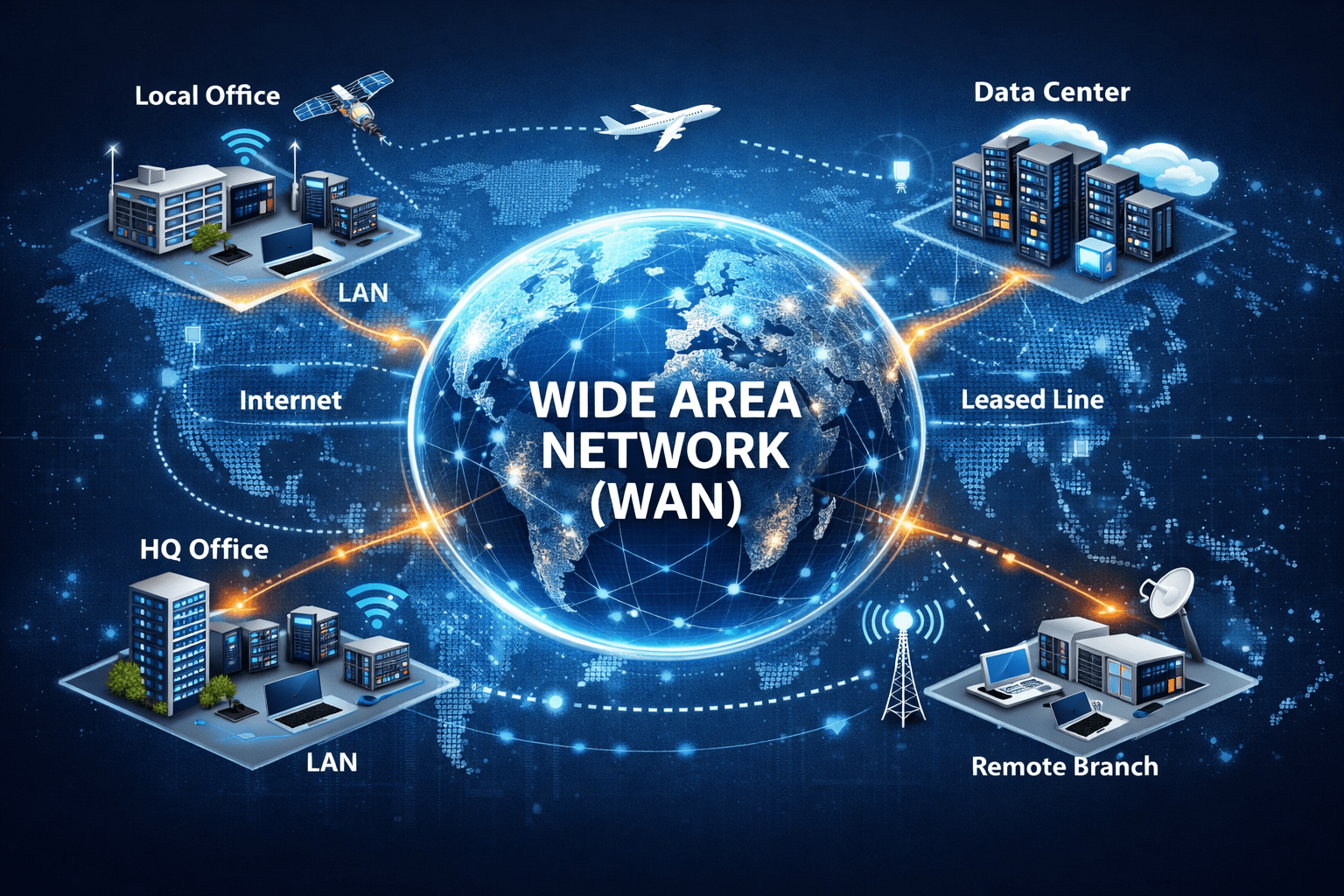
A wide area network (WAN) is a data network that connects local area networks (LANs) across cities, countries, or even the world. In simple terms, a WAN is a network that lets LAN endpoints in multiple locations communicate, share resources, and run critical applications over long distances. The public Internet is the world’s largest WAN, but enterprise WANs often combine private networks, leased lines, and open Internet access links to balance security, cost, and reach.
How WANs Work
A WAN links network devices and sites using varied networking technologies. Data moves as data packets or encapsulated packets that follow a communication protocol from one location to another. Standard underlay transports include optical fiber and fiber optics, telephone lines, microwave, and cellular. Legacy WAN protocols, such as Frame Relay and Asynchronous Transfer Mode (ATM), utilized fixed-sized cells and virtual circuits. Modern MPLS technology (multiprotocol label switching) provides predictable paths and QoS for data transmission. These underlays create virtual connections and sometimes direct or fixed connections between sites.
Above the underlay, routing and tunneling shape data flow and data traffic. SD-WAN (software-defined WAN) overlays choose the best path over public internet or private links, steer around congestion, and prioritize voice, video, and other critical applications. The result is a more unified network experience across branch offices and data centers.
WAN Architectures and Services
Organizations can connect LANs using several WAN architectures and internet services:
- Leased lines for private, symmetric bandwidth between sites.
- MPLS for predictable performance and traffic engineering across carrier clouds.
- SD WAN for policy-based path selection across mixed links such as broadband, 5G, and DIA.
- Direct connection to cloud providers for steady throughput and lower jitter.
- Public network options using secure tunnels over the Internet for cost efficiency.
These choices enable smaller networks and large enterprises to design network infrastructure that fits their budget and risk profiles.
Improving WAN Performance
WAN performance affects user experience for apps, voice, and video. Techniques for improving network performance include:
- WAN optimization appliances that compress data, deduplicate repeated patterns, cache objects, and accelerate protocols to improve performance over distance.
- Traffic shaping and QoS to reserve bandwidth for critical applications.
- Path diversity with SD-WAN enables seamless failover and avoids brownouts.
- Monitoring of network performance and internet connection health to detect loss, latency, and jitter.
Together, these measures raise reliability for headquarters, branch offices, remote workers, and cloud workloads.
When to Use a WAN
You need a WAN when teams and systems are not located in the same place. Typical use cases:
- Linking offices across regions so staff can share resources securely.
- Extending ERP, VoIP, and video between sites with predictable data flow.
- Providing resilient access to SaaS and cloud with policy-based SD-WAN.
- Supporting mission-critical sectors, from retail to the air force, where uptime and security are essential.