Table of Contents
- Why SMBs Need a Practical Cybersecurity Starting Point
- What Is a Broad Security Assessment?
- Why Tools Alone Do Not Solve Cybersecurity for SMB with Limited Resources
- How a Broad Security Assessment Simplifies the Process
- Broad Security Assessment vs. Penetration Testing
- When Small and Medium-Sized Businesses Should Consider a Broad Security Assessment
- A Better Roadmap for Cybersecurity Best Practices for SMBs
- Turn Security Gaps Into Practical Next Steps
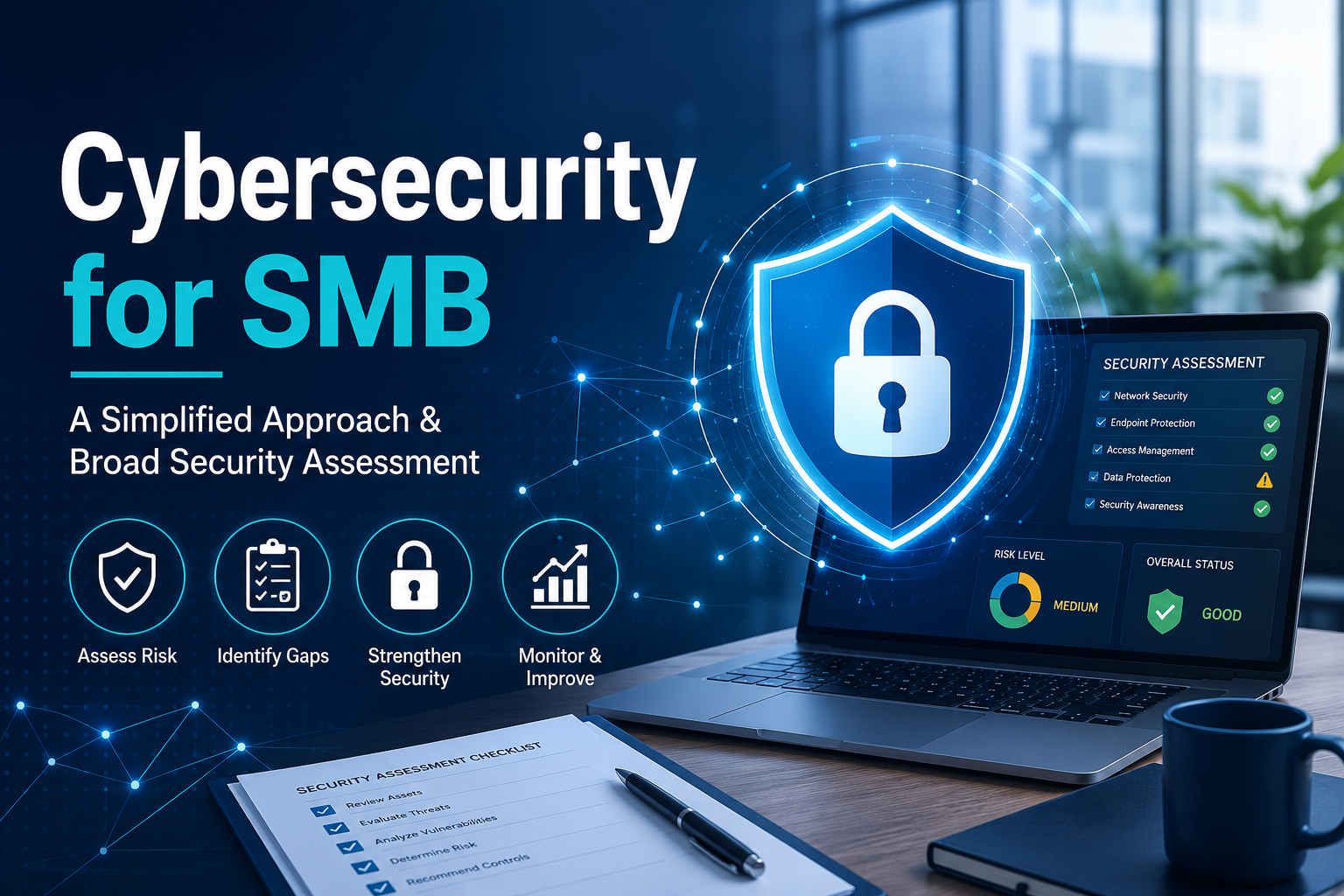
Cybersecurity for small and medium-sized businesses (SMBs) can feel overwhelming when your team is already balancing daily operations, customer needs, technology issues, and budget constraints. Many SMBs face growing cybersecurity challenges posed by rapidly evolving cyber threats, but they are not always sure where to start.
For some companies, the first instinct is to buy another tool, run a vulnerability scan, or schedule a penetration test. These can be valuable, but they may not answer the bigger question: how secure is the business overall?
That is where a broad security assessment can help. Instead of focusing only on firewalls, endpoints, cloud systems, or external vulnerabilities, it reviews cybersecurity across the wider business environment. This includes people, processes, physical safeguards, policies, access controls, technology, third-party risks, cybersecurity measures, network security, secure devices, mobile devices, and the protection of sensitive data and business data.
For SMBs, this broader view can make cybersecurity more practical, easier to understand, and easier to prioritize.
Why SMBs Need a Practical Cybersecurity Starting Point
Small and medium-sized businesses often face cyber risks with limited IT resources, smaller teams, and security processes that may not be fully documented or consistently followed. In Japan, this concern is clear. A 2025 survey found that 30.3% of Japanese SMEs had experienced a cyberattack, while 6.9% reported one in the past month.
For many SMBs, the challenge is not a lack of concern. Business owners and managers want to protect their systems, data, people, and customers. The bigger issue is knowing where to start.
Common questions include:
- Which risks need attention first?
- Are current policies being followed in daily operations?
- Do staff know how to recognize and report suspicious activity?
- Are access rights reviewed when employees change roles or leave?
- Are vendors and third parties managed securely?
- Are physical locations and devices properly protected?
- Are controls documented, tested, and maintained?
A Broad Security Assessment helps answer these questions in a structured way, giving SMBs a clearer view of their security gaps and a practical roadmap for improvement.
What Is a Broad Security Assessment?
A Broad Security Assessment is a structured review of an organization’s security posture across people, processes, physical environments, and technology, helping an SMB evaluate its overall cybersecurity posture and risks, rather than isolated gaps. For SMBs, it helps identify practical security gaps that may not appear in a technical scan alone, such as unclear policies, weak access controls, inconsistent procedures, staff awareness issues, and supplier-related risks.
Rather than focusing on a single system or vulnerability, the assessment provides a broader view of how security controls operate across daily operations. The result is a clearer baseline, practical risk ratings, and prioritized recommendations that support a practical cybersecurity plan and better security decisions about what to improve first.
Why Tools Alone Do Not Solve Cybersecurity for SMB with Limited Resources
Cybersecurity tools and cybersecurity solutions can help protect systems, detect threats, and reduce exposure. However, tools are only one part of a stronger security posture.
For example, antivirus software can help identify malicious activity, while multi-factor authentication (MFA) adds an extra verification step that can help prevent unauthorized access when a password is stolen. However, these tools cannot address every security gap. A business may still face risk when:
- Former employees still have access to systems, instead of access being limited to authorized people only
- Password policies are not consistently followed, with weak password management practices instead of strong passwords and long, complex passphrases
- Staff are not trained to recognize phishing attacks, social engineering, malicious links, and the risk of giving away sensitive information that can lead to malware attacks or ransomware attacks
- Vendors have broad access without regular review
- Security policies exist but are not used in daily operations
- Backups are not tested
- Physical access to offices or equipment is loosely controlled
A cybersecurity strategy needs to connect business risks, user behavior, operational processes, and technical safeguards. A Broad Security Assessment helps SMBs see these connections more clearly.
How a Broad Security Assessment Simplifies the Process
A practical assessment turns a broad and sometimes overwhelming topic into a clear sequence of findings and next steps.
1. It Gives Management a Clear View of Risk
Security issues are easier to address when they are explained in business terms. A Broad Security Assessment helps leadership understand which gaps create the highest risk, which controls are already working, and where investment can have the greatest impact.
2. It Compares Policies With Daily Practice
Many organizations have policies, but those policies may not reflect what happens day-to-day. An assessment can identify gaps in access approvals, employee onboarding and offboarding, vendor access, device management, password practices, and incident response planning.
3. It Looks Beyond Technology
Cybersecurity is not limited to tools or the IT department. Employees, managers, vendors, facilities, and business processes all play a role. A broad review helps SMBs identify risks across people, processes, physical environments, and technology.
4. It Prioritizes Action
Not every issue carries the same level of risk. A strong assessment separates urgent concerns from lower-priority improvements, giving SMBs a practical roadmap instead of a long list of disconnected findings.
Broad Security Assessment vs. Penetration Testing
While both strengthen cybersecurity, a penetration test and a broad security assessment serve entirely different purposes.
Penetration testing focuses narrowly on identifying and exploiting technical vulnerabilities within a specific network, application, or environment. While highly valuable for deep technical validation, it is not a substitute for foundational, ongoing security controls like automated patch management, regular asset audits, and baseline access protections.
In contrast, a Broad Security Assessment evaluates an organization’s entire security posture. It examines high-level governance, policies, employee awareness, supplier risks, and technical safeguards. This includes analyzing secure remote work setups (such as VPN encryption) and on-premises Wi-Fi defenses (such as network segmentation and WPA3 encryption).
The Strategic Approach: A comprehensive security assessment is the most practical first step for SMBs. This evaluation maps the risk landscape and validates essential controls, such as a functional 3-2-1 backup strategy with an encrypted offline copy. After addressing these foundational gaps, organizations can leverage targeted penetration testing for deeper technical validation
When Small and Medium-Sized Businesses Should Consider a Broad Security Assessment
A Broad Security Assessment can be especially useful when a business needs to move from general cybersecurity concerns to clear, practical action. This is especially important for medium-sized businesses that may have growing systems, expanding teams, more supplier relationships, and limited internal security capacity. It provides leadership with a clearer view of current risks, existing controls, and the most important next steps to improve security.
A Broad Security Assessment can help when your organization needs to:
- Establish a baseline for cybersecurity improvement
- Prepare for customer, partner, or vendor security reviews
- Review security before expanding systems, locations, or remote work arrangements
- Strengthen controls for employee devices, mobile devices, and secure remote access
- Improve policies, procedures, and internal controls
- Identify gaps in access management
- Assess supplier and third-party risks
- Support compliance or governance discussions
- Build a practical cybersecurity roadmap
- Decide where to invest limited security resources
The need for a structured cybersecurity review is clear. Japan’s National Police Agency reported that ransomware incidents involving SMEs increased by 37% in 2024 compared with the prior year. Separately, the Information-technology Promotion Agency found that only 39.8% of surveyed SMEs had fully or partially prepared emergency structures and response procedures for a security incident. Together, these findings provide evidence that many Japanese SMEs face ongoing cyber risk and may benefit from a structured review and specialist support when internal security capacity is limited.
A Better Roadmap for Cybersecurity Best Practices for SMBs
Cybersecurity for SMB does not need to begin with a complicated program or a large investment. It can start with a clear understanding of where risk exists and which improvements matter most.
EIRE Systems provides IT Security Services and Broad Security Assessment support for organizations that need a practical, business-focused view of their security posture. The assessment helps identify technical and non-technical gaps, validate existing controls, and prioritize improvements.
For SMBs, this creates a more manageable path forward. Instead of reacting to every concern at once, your business can focus on the risks that matter most and strengthen its security foundation step by step.
Turn Security Gaps Into Practical Next Steps
Better cybersecurity starts with visibility. A Broad Security Assessment helps SMBs understand where they stand today, what needs attention, and how to move forward with confidence.
If your organization needs a clearer view of its security posture, contact EIRE Systems to discuss a Broad Security Assessment.
Sources:
- Teikoku Databank, Ltd. (2025, June 19). サイバー攻撃に関する実態調査(2025年) [Survey on cyberattacks (2025)]. https://www.tdb.co.jp/report/economic/20250619-2025cyber-attack/
- Information-technology Promotion Agency, Japan. (2026). Information security awareness promotion initiatives for SMEs. https://www.ipa.go.jp/en/about/activities/security-action.html
- Ministry of Economy, Trade and Industry. (n.d.). Cybersecurity. https://www.meti.go.jp/english/policy/safety_security/cybersecurity/index.html
- National Center of Incident Readiness and Strategy for Cybersecurity. (2024). Overview of cybersecurity 2024. https://www.cyber.go.jp/eng/pdf/overview_of_cybersecurity2024_en.pdf
- Information-technology Promotion Agency, Japan. (2025, May 27). 2024年度 中小企業における情報セキュリティ対策に関する実態調査報告書 [Report on the 2024 survey of information security measures among small and medium-sized enterprises]. https://www.ipa.go.jp/security/reports/sme/sme-survey2024.html
- National Police Agency. (2025, March 13). 令和6年におけるサイバー空間をめぐる脅威の情勢等について [Threat landscape in cyberspace in 2024]. https://www.npa.go.jp/publications/statistics/cybersecurity/data/R6/R06_cyber_jousei.pdf
- Keeper Security & Ponemon Institute. (2017). 2017 State of Cybersecurity in Small & Medium-Sized Businesses. https://www.keepersecurity.com/assets/pdf/Keeper-2017-Ponemon-Report.pdf
About the Author: Colin Silvester

Colin Silvester is General Manager at EIRE Systems and an experienced technology leader with more than two decades in IT and management. His background spans IT security, corporate governance, digital transformation, and technology strategy, complemented by postgraduate study in cybersecurity.