
Table of Contents
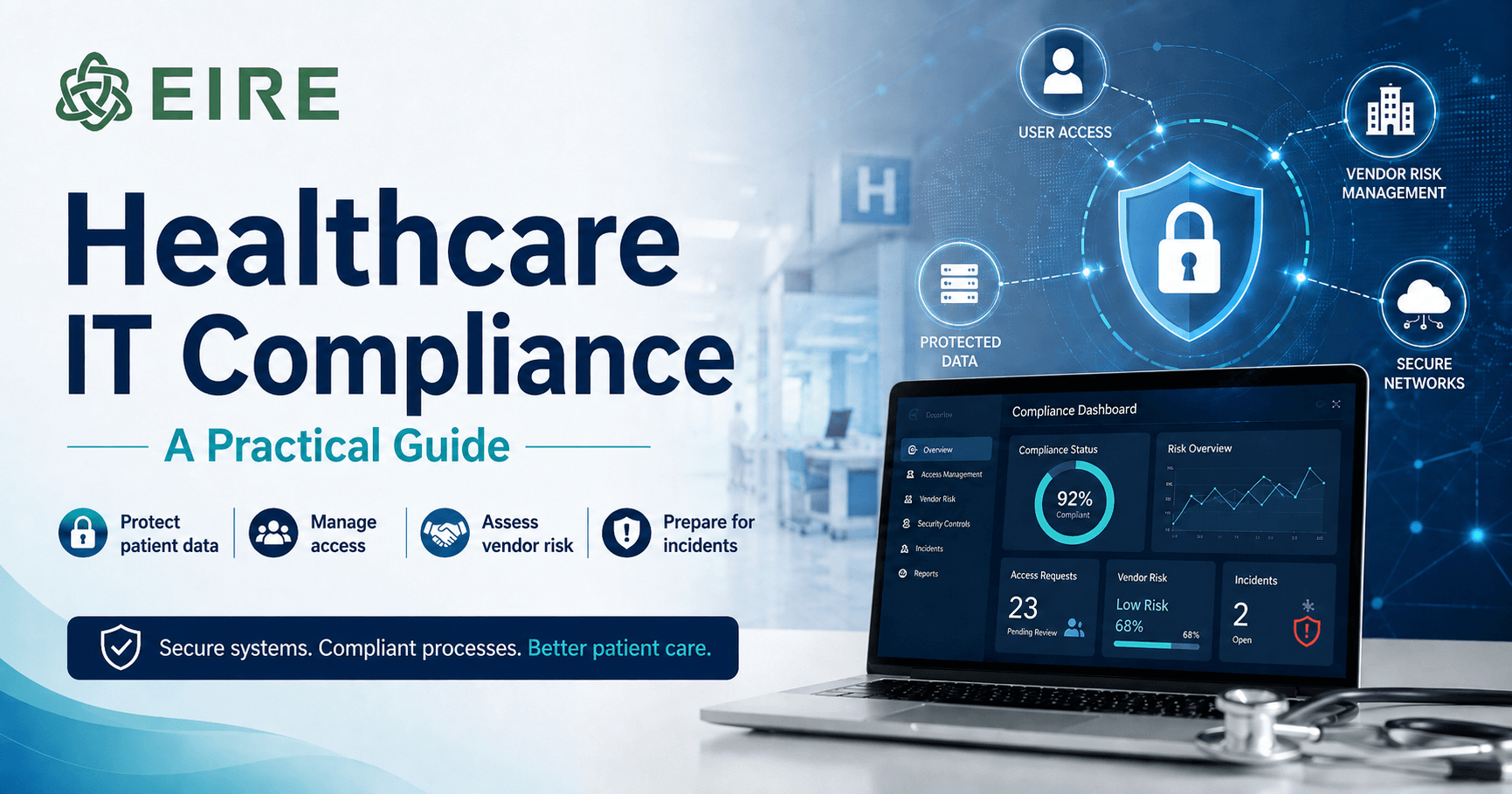
Healthcare organizations operate in a complex digital ecosystem. Medical facilities depend on electronic health records (EHR), diagnostic imaging systems, scheduling tools, patient portals, billing platforms, mobile devices, cloud applications, and third-party services. While these connections support rapid patient care, they also introduce significant risk to sensitive health information, clinical system availability, and patient trust.
Healthcare IT compliance aligns these technical systems and administrative workflows with applicable privacy laws, cybersecurity frameworks, contractual obligations, and operational requirements. It is not just a periodic audit exercise. A practical compliance program actively protects protected health information (PHI), limits inappropriate access, ensures reliable care delivery during outages, and demonstrates that key security controls are functioning.
What Is Healthcare IT Compliance?
Healthcare IT compliance encompasses the policies, technical safeguards, governance processes, and documented evidence used to manage healthcare information responsibly. Obligations vary by jurisdiction, but most programs address foundational standards. In the U.S., this includes HIPAA (mandating the safeguarding of electronic PHI) and the HITECH Act (reinforcing HIPAA’s privacy and security rules).
Regardless of the specific framework, mature compliance programs actively address:
- Data Lifecycle Management: Secure collection, use, encrypted storage, retention, transfer, and disposal of patient data.
- Access and Identity: Strict role-based access controls (RBAC), multi-factor authentication (MFA), and rapid offboarding.
- Infrastructure Defense: Endpoint protection, network segmentation, cloud configuration, and connected medical device (IoMT) security.
- Threat Visibility: System logging, threat monitoring, vulnerability management, and timely patching.
- Supply Chain Security: Vendor due diligence, third-party risk assessments, and contractual security expectations.
- Resilience and Recovery: Incident response protocols, business continuity planning, and frequent recovery testing.
- Human Firewall: Ongoing staff training, updated policies, and regular executive review.
Compliance extends beyond the core EHR. Sensitive information routinely exists in corporate email, collaboration tools, legacy imaging systems, and staff devices. An effective program identifies exactly where this data is held, who accesses it, and how it safely moves between systems.
The Cost of Non-Compliance
Failing to maintain a robust IT compliance posture carries severe consequences. According to industry reports, the healthcare sector consistently experiences the highest average cost of a data breach. Non-compliance can trigger massive legal penalties, class-action litigation, and severe reputational damage. Furthermore, ransomware attacks—often stemming from weak access controls or unpatched systems—cause operational downtime, forcing hospitals to divert ambulances and delay surgeries, directly threatening patient safety.
Why a Checkbox Approach Creates Risk
A standard compliance checklist cannot replace genuine operational discipline. Organizations need dynamic security controls that address real-world risks rather than static paper requirements.
A written access-control policy is completely ineffective if IT lacks the processes to disable former employees’ active network accounts upon termination. Similarly, deploying advanced encryption cannot protect sensitive data if users are permitted to download it onto unmanaged, personal mobile devices. Healthcare IT compliance must be treated as a continuous lifecycle, actively reassessed whenever new systems are deployed or workflows are altered.
Compliance Requirements Depend on Your Footprint
Your specific compliance obligations are dictated by where you operate and whose data you process.
Key Compliance Considerations in Japan
For healthcare organizations operating in Japan, IT compliance means strictly protecting medical information across all clinical systems and business platforms. Organizations must adhere to:
- Japan’s Act on the Protection of Personal Information (APPI): The foundational privacy law governing data handling.
- MHLW Guidelines: The Ministry of Health, Labor and Welfare’s specific guidance on the safe management of medical information systems.
- Sector-Specific Guidance: Healthcare-sector privacy and cybersecurity frameworks recommended by local authorities.
- Contractual Mandates: Specific security requirements dictated by health insurers, business partners, and cloud providers.
Navigating Global Frameworks
If your organization handles EU citizens’ data or operates in regulated regions like California, you must account for strict data collection rules under frameworks like the General Data Protection Regulation (GDPR) and the California Consumer Privacy Act (CCPA). Depending on your international footprint, you may also need to align with Center for Medicare & Medicaid Services (CMS) rules, the False Claims Act, and EMTALA.
Practical Areas to Review
Organizations seeking to baseline their current compliance posture should regularly evaluate:
- Access Controls: Who has the technical ability to view, edit, download, or share patient information.
- User Accounts: Workflows for how accounts are provisioned, reviewed, modified, and terminated.
- Data Handling: Where patient information is stored, transferred, backed up, and securely disposed of.
- Vendor Risk: Verification that managed service providers have audited security controls in place.
- Business Continuity: Tested procedures for maintaining critical patient care during severe IT outages.
Unsure if your current IT controls meet these complex regulatory standards? Contact EIRE Systems for a Broad Security Assessment to identify critical vulnerabilities across your people, processes, and technology.
6 Building Blocks of a Strong Compliance Program
1. Clear Governance and Risk Ownership
Compliance requires formal, funded programs with accountable executive owners. Many healthcare organizations formalize oversight through a compliance committee and designated leadership. Define clear responsibility for data privacy, cybersecurity, clinical system management, and incident handling so compliance initiatives have ownership and become part of the organization’s culture, with accountable oversight that reinforces ethical standards. Maintain a centralized risk register that tracks affected systems, potential business impacts, compliance risks, control owners, remediation deadlines, and the risk management actions tied to each item.
2. Identity and Access Management (IAM)
Give users only the minimum access necessary to perform their clinical or administrative roles, and support compliance efforts with employee training that reduces insider misuse and social engineering risks. Apply strong multi-factor authentication (MFA) to all remote access points and privileged administrator accounts. Review these high-risk accounts quarterly, and reinforce secure access practices through regular training programs. Revoke access instantly when staff or vendors leave. Insider threats, whether malicious or accidental, can easily exploit poorly managed internal access to cause catastrophic damage.
3. Protection Throughout the Data Lifecycle
Organizations must actively classify healthcare data, protect data integrity, and map exactly where it lives. Apply robust security safeguards, like encryption and secure file-sharing platforms, to protect patient privacy and data security while data is in use, in transit, at rest, and when ready for disposal. Old diagnostic reports and retired medical devices create unnecessary exposure, making strict media-sanitization processes a critical compliance requirement.
4. Secure, Reliable Clinical Technology
Maintain a precise, continuously updated asset inventory for all workstations, servers, network equipment, connected medical technology, and connected devices. Plan software patching carefully around clinical availability to ensure patient safety. Healthcare systems are also exposed to cybersecurity threats through connected devices, and resilient design helps support operational resilience. Adopting a “Zero Trust” architectural approach, including strict network segmentation, limits the blast radius of a compromised device, ensuring malware on a reception workstation cannot easily spread to critical imaging equipment.
5. Vendor and Cloud Oversight
Healthcare organizations remain legally responsible for risks introduced by the third-party services they consume. Before onboarding a new cloud hosting provider or specialized software vendor, heavily assess how they manage internal access, encryption protocols, incident response, and their own subcontractors.
When cloud adoption is part of the strategy, business cloud solutions should be designed alongside identity management, logging, backups, data classification, and continuity requirements, not added after deployment.
Struggling to manage hidden third-party risks across your complex supply chain? Contact EIRE Systems for a comprehensive vendor security review and ensure your partners meet strict, auditable compliance standards.
6. Incident Response and Business Continuity
A compliance program is incomplete without a thoroughly tested incident response plan. Continuous monitoring helps identify potential threats before they disrupt essential care. Identify exactly who has authority to make critical decisions, how essential medical services, including telehealth services where applicable, will continue operating during an IT blackout, and when regulatory notifications must be triggered. Run quarterly tabletop exercises simulating ransomware attacks or cloud outages to verify that critical patient records can actually be restored from backups in time to support urgent clinical care.
How to Start IT Compliance in Healthcare
You do not need to solve every complex compliance issue overnight. Organizations can maintain compliance despite evolving regulations by following a structured, phased approach:
- Map: Thoroughly inventory your sensitive data, clinical systems, mobile devices, locations, and vendors.
- Identify: Document the specific privacy laws, commercial contracts, compliance guidelines, and internal security standards that apply directly to your operational footprint.
- Assess: Conduct regular risk assessments to identify high-risk gaps in access control, backup integrity, software patching, system logging, and incident readiness.
- Prioritize: Rank remediation efforts based on immediate patient-safety impact, operational importance, and regulatory exposure.
- Execute: Assign specific task owners, preserve audit evidence, set aggressive but realistic target dates, support continuing education, and review remediation progress regularly.
Need help building a manageable, financially sound compliance roadmap? Let the IT consulting experts at EIRE Systems guide your strategic planning. Contact us today to schedule an initial infrastructure review.
Build Compliance Into Everyday Healthcare Operations
Healthcare IT compliance works best when it is embedded in everyday operations and the organization’s culture across healthcare providers, from how technology is procured and configured to how it is supported and eventually retired. Strong, integrated security controls help with maintaining trust by supporting secure access, strengthening data security, and enabling reliable care that helps maintain patient trust. Compliance should be an enabler of secure, efficient healthcare delivery, and ongoing regulatory compliance supports sustainable healthcare services, not just a preparation exercise for the next audit.
EIRE Systems helps healthcare organizations build the resilient technology foundations necessary to support aggressive compliance goals through advanced IT security services, secure cloud infrastructure design, strategic project planning, and ongoing technical support. Contact EIRE Systems to discuss securing your healthcare IT environment today.
Disclaimer: This article provides general educational information and does not constitute formal legal advice. Always obtain qualified legal and privacy guidance tailored to your organization’s relevant jurisdictions and specific operational circumstances.
Sources
- Marron, J. (2024). Implementing the Health Insurance Portability and Accountability Act (HIPAA) Security Rule: A cybersecurity resource guide (NIST Special Publication 800-66 Rev. 2). National Institute of Standards and Technology.https://doi.org/10.6028/NIST.SP.800-66r2
- Centers for Disease Control and Prevention. (2024, September 10). Health Insurance Portability and Accountability Act of 1996 (HIPAA).https://www.cdc.gov/phlp/php/resources/health-insurance-portability-and-accountability-act-of-1996-hipaa.html
- Alder, S. (2025, December 3). What is the HITECH Act? The HIPAA Journal. https://www.hipaajournal.com/what-is-the-hitech-act/
- Ministry of Health, Labour and Welfare. (2026). Guidelines on the safe management of medical information systems (Version 7.0 draft) [Guideline].https://www.mhlw.go.jp/content/10808000/001705955.pdf
- Personal Information Protection Commission. (2023). Act on the Protection of Personal Information (Consolidated text as of April 1, 2023).https://www.ppc.go.jp/en/legal/
About the Author: EIRE Systems

EIRE Systems is a leading independent provider of professional IT, AV and Access Security services to the financial, insurance, manufacturing, health care, retail, construction, hospitality, commercial real estate, legal, educational and multinational sectors in Japan and throughout the Asia Pacific region. EIRE Systems has expertise across a wide spectrum of Information Technologies, with a track record for successfully completing hundreds of assignments since its establishment in 1996.